
Most of the AI conversation over the last few years has been about what it might eventually do. One thing it already does, reliably, is write software for people who aren’t coders.
That's vibe coding, and for a small business owner it's a bigger shift than it sounds. Software you wanted but could never justify — required a developer, a quote, and a six-week wait — is now an afternoon and a conversation.
Like any tool though, the value is in what you point it at. Some of what a facility runs on is worth building yourself this week. The parts that aren’t will cost you more than they save, and you may not find out for months.
In this article we’ll go over some of the areas where vibe coding can be beneficial to you as a facility owner, some where it’s not worth it, and a couple of examples you can try.
What Is Vibe Coding?
Vibe coding is building software by describing what you want in plain language and letting an AI write the code.
You open a tool like ChatGPT or Claude, describe what you want — "a page that builds a round-robin schedule from a list of team names" — and it writes, builds, and ships something you can interact with. All you do from there is tell your AI what’s wrong and it goes back and makes the adjustments for you.
It works better than most people expect. There’s a wide variety of examples people have created across industries, all without a coding background.
What that means for you: almost anyone can build working software now, so the decision that matters is how you use it.
What Can You Build With AI at a Sports Facility?
At a sports facility, vibe coding is best pointed at the tools where being wrong costs you nothing but a redo. A few things worth trying:
- A tournament bracket generator shaped exactly like the format you run, instead of the spreadsheet you keep rebuilding.
- A workout or throwing program builder that returns a printable plan per athlete.
- An interactive pricing model that shows what a rate change does to your month.
- An internal checklist tool for opening and closing, or for camp week prep.
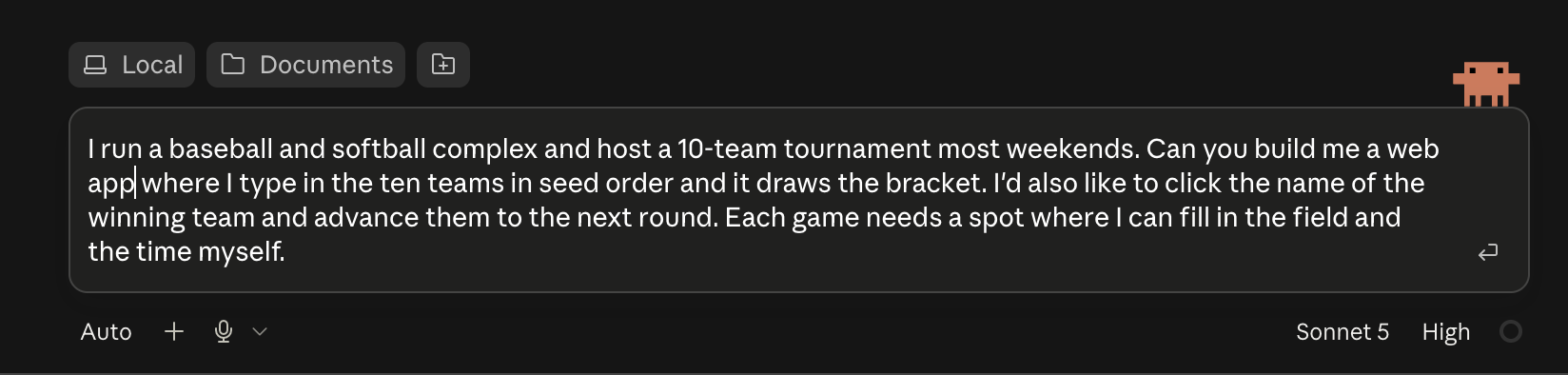
The bracket generator is one worth experimenting with over a weekend. Describe how many teams and fields you have, what time play starts, any branding you want, and anything else that matters, and an AI tool can build a page that seeds the draw itself and advances the winner whenever you click their name.
Next season it's the same page with new names typed in, not a rebuilt spreadsheet or a request to whoever wrote the code.

Most of this you could also get out of a standard chat window with ChatGPT or Claude, and for a one-off that’s usually faster. Building the tool pays off when the same task comes back. The same tournament format every season, the coach who wants the program builder while you’re out of town, etc.
We wrote more about where AI earns its keep at a facility in our beginner-friendly AI guide for owners, including the tools worth starting with.
While vibe-coding is great for many situations, there are also instances where you want to trust external software. The clearest example is your booking system.
What Breaks When You Build Your Own Booking System
Money, personal data and timing are the places where a mistake costs more than a rebuild. Your booking system sits on all three. A missed or double charge costs you revenue, and you're the one explaining it to the parent. Contact details and kids' names come with legal obligations as well, and it has to be right about who has which cage at what time, including when two parents tap "book" in the same second.
Most facility owners think that vibe-coding will help them save the $200/mo they’re spending on their scheduling software. But this misses some key things — it leaves out where vibe coded software can fail, and what it costs you in time, energy, and money.
What can go wrong with a booking system you built yourself?
AI-generated code usually runs. The gaps are in the situations you didn't think to test, and in a booking system those situations happen in front of customers.
Two parents tap "book" on cage four in the same second and both get it. A parent closes the tab a second before the payment finishes, gets no confirmation, and shows up Saturday certain they're booked. You won't find either of these by clicking through the page yourself. They turn up weeks after launch, when a customer hits one and calls you.
Security is the part you can't check by looking. Whatever the AI builds needs somewhere to keep your bookings, and that's where every family's contact details end up. Whether that database is readable by anyone who finds it comes down to settings you may not be familiar with. If it does get out, every US state requires you to notify the families affected, in writing, under your facility’s name.
Who maintains a self-built booking system?
Software isn't finished when it launches. Every month it's running, something needs attention, and all of it lands on you.
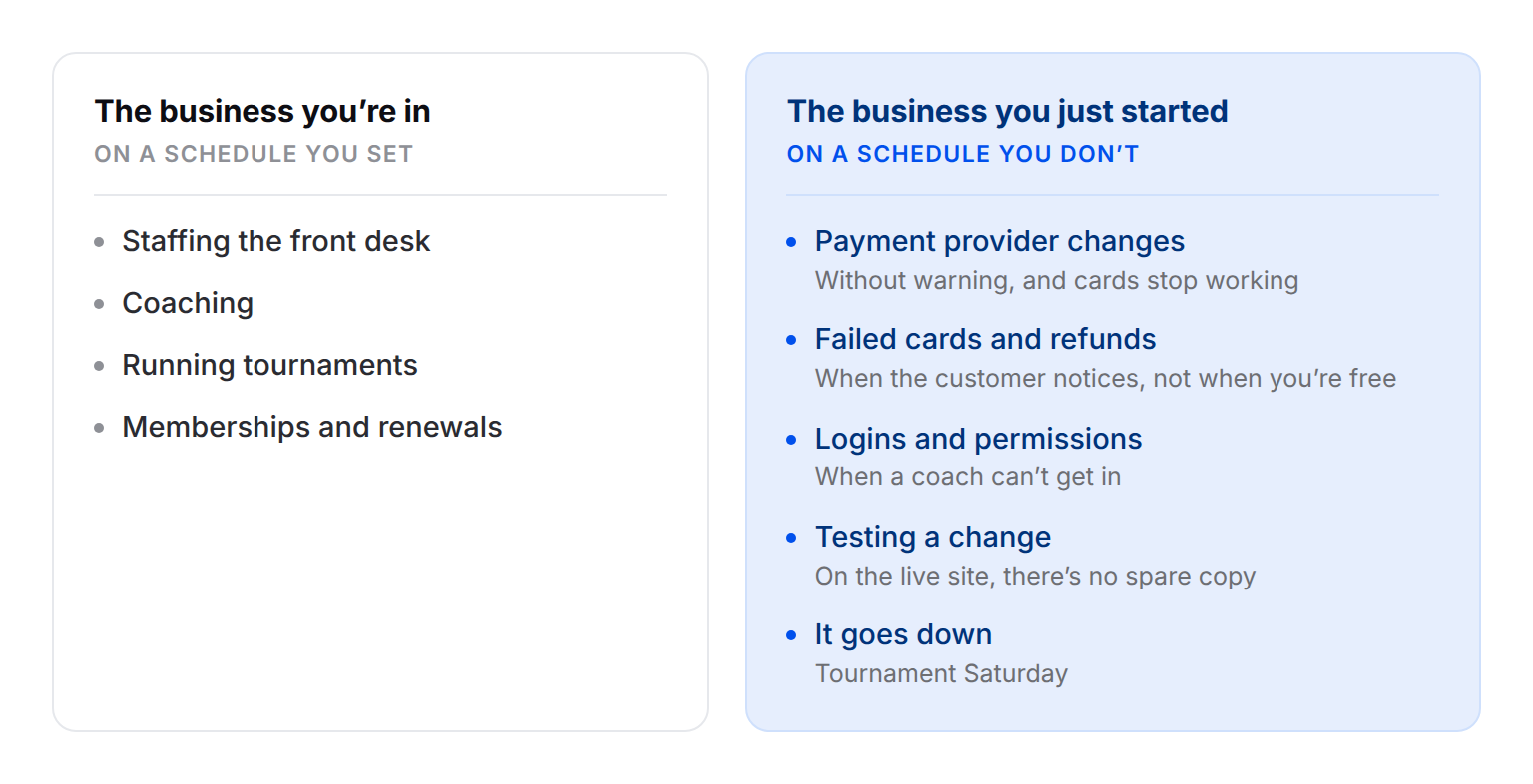
Your payment provider changes something and the page stops taking cards. Anything you want to fix or add gets done on software that's already live and taking bookings because there's no spare copy to try it on first.
You're also the support desk. Logins and refunds come to you now when the customer notices rather than when you're free, and you're the only person who can do anything about them, not your front desk (unless you take the time to train them). If it goes down on a tournament Saturday, you're in the office at a laptop instead of on the floor.
People who write software for a living have test suites and someone on call for exactly that reason. Maintaining the software, that becomes a second job in a field you didn't train for, while the first one is still staffing the place and keeping the facility profitable.
How much does a self-built booking system cost to run?
Four costs recur: the builder’s monthly hosting fee, the AI subscription you prompt when something needs changing, card processing at Stripe's standard US rate of 2.9% + $0.30 online as of August 2026, and another 0.7% on top for memberships billed through Stripe’s Billing product. Skip Billing and the failed-card emails and invoicing are yours to build and keep working too.
If it breaks in a way you can't prompt your way out of, you’re paying a developer by the hour to figure out how your own app was built and fix it. Until they do, nobody can book and the parents who are trying to are calling you.
In practice: on a platform like Swift that handles booking and payments for you, all of this is somebody else's job. Engineers maintain it, and a support team picks up when something's wrong. The costs don't disappear, but they arrive as one bill you can plan around instead of costs you find one at a time.
We break down the other costs owners don't budget for in 5 hidden costs of starting a sports facility.
When Is It Fine to Build Your Own Booking System?
Building your own is fine for a facility with one room, a handful of time slots, and customers who pay when they show up. No memberships, credits, or waivers. That’s something that can be built in a weekend.
Most facilities aren’t that simple though. Once money moves before people arrive you’re getting into payments, memberships, waivers and tax, and all of it requires upkeep once the page is live.
That upkeep doesn't have to fall entirely on you, and avoiding it doesn’t mean giving up what made vibe coding appealing in the first place.
The Better Version: AI Inside Purpose-Built Software
The tools you’d have built yourself are starting to show up inside the software that already handles the parts you can’t afford to get wrong.
That’s what we’re building at Swift. The AI isn’t writing your payment and scheduling logic — that already exists and we maintain it. It works on top of that. Here’s some of the AI enabled features we’ve built and are releasing soon:
- The Swift AI Connector is live. Connect Claude or ChatGPT to Swift and ask about your own business in plain language, like "which customers still have unused credits." It's read-only, and it respects each staff member's existing permissions.
- Intelligent suggestions: Name a new collection and Swift Intelligence will suggest which of your services belong in it, so you start from a list you can accept or dismiss rather than a blank page.
- AI front desk agent: Imagine a front desk agent that’s always on — 24x7. Able to do everything a human can, take bookings, handle cancellations, even escalate if they’re not sure.
- Swift websites: a website builder for facilities sitting on the booking engine you already run. It’s the same site you were planning to vibe code, except we manage the hosting and keep it running.
The creative parts stay yours. The rest is handled by people who do this all day.
If you take one thing from this, it's to try building the small stuff. Pick the tool you keep rebuilding in a spreadsheet and spend a Saturday on it because you don’t lose revenue if it's wrong.
If you want to see how Swift handles the rest, book a free demo and we'll walk you through it.
Frequently Asked Questions
Do I need to know how to code to build my own software?
No. You describe what you want in plain language, and the AI writes it, builds it and puts it online. The skill is describing clearly what you want, not writing code.
What can I build with AI at a sports facility?
Tournament bracket generators, workout and throwing program builders, pricing models, or opening and closing checklists are all realistic and simple builds you can tackle in an afternoon.
What's the best AI tool for building a simple app?
If you already use ChatGPT or Claude, that’s the easiest starting point, both will build something from a description. Lovable and Replit are purpose-built for it and host the result for you if you want something more suited to the job.
How long does it take to build something?
An afternoon gets you a first working version of something simple, like a bracket generator or a checklist tool. Getting it exactly how you want usually takes a few more rounds of telling it what's wrong.
What shouldn't I build with AI?
Anything where being wrong costs more than a rebuild. If it charges a card, holds customer personal data, or has to be right at a specific time in public, the failures are expensive and they tend to surface weeks later, in front of a customer.

.png)


