The median indoor sports facility on Swift recorded $72,174 over the last 12 months, and the middle half recorded $20,346 to $195,505 (303 US facilities). The busiest pass $1M a year. With margins of 10% to 20%, a facility doing $250,000 keeps about $25,000 to $50,000.
Below we break down where that revenue comes from, what the top-earning facilities do differently, how revenue varies by region, and the costs that eat into it. In the past we've also shared tips for increasing a facility’s profitability.
Key takeaways
- The median facility on Swift recorded $72,174 over the last 12 months. The middle half recorded $20,346 to $195,505, and the busiest pass $1M a year.
- Margins usually run 10% to 20%, so a facility doing $250,000 in revenue keeps about $25,000 to $50,000.
- Memberships, rentals and lessons bring in nearly three quarters of revenue.
- The top-earning quarter of facilities (median $307,724 a year) gets 23% of revenue from lessons and 14% from rentals. The bottom quarter (median $9,003) gets 8% from lessons and 42% from rentals.
- Revenue varies by region. The median facility on Swift recorded $114,687 in the West and $48,255 in the Midwest.
- Rent is usually the biggest cost, followed by instructor payroll if you run a lot of lessons.
- The busier you are, the better your margins. Rent and payroll stay the same no matter how many hours you book, so every extra booking adds to your profit.
Where facility revenue comes from (300+ facilities on Swift, last 12 months)
| Revenue stream | Share of revenue |
|---|---|
| Memberships | 32% |
| Rentals | 26% |
| Lessons | 16% |
| Camps | 7% |
| Packages | 6% |
| Classes | 5% |
| Other services | 8% |
What the Top-Earning Facilities Do Differently
We split US facilities on Swift into four equal groups by annual revenue and compared where each group's money comes from. Memberships stay between about 30% and 38% of revenue in every group. What changes is the balance between rentals and lessons.
Revenue mix by revenue quarter (US facilities on Swift, Oct 2025 to Sep 2026, about 75 facilities per quarter)
| Revenue quarter | Median annual revenue | Memberships | Rentals | Lessons | Camps | Packages | Classes |
|---|---|---|---|---|---|---|---|
| Top | $307,724 | 31% | 14% | 23% | 8% | 7% | 6% |
| Upper middle | $114,466 | 30% | 21% | 21% | 8% | 6% | 3% |
| Lower middle | $39,718 | 38% | 28% | 13% | 9% | 5% | 4% |
| Bottom | $9,003 | 29% | 42% | 8% | 4% | 8% | 5% |
The highest-earning facilities get more than three times the share of revenue from lessons that the lowest-earning ones do, and well under half the share from rentals. They also spread their revenue wider. The median top-quarter facility gets at least 5% of its revenue from three different streams, compared with two for the bottom quarter.
That doesn't mean dropping rentals. Rentals fill the calendar and bring in new customers. But a facility that only rents space is capped by its hours, while lessons, camps and classes earn more from the same cage or court. If most of your revenue is rentals today, adding instructors and programs is usually the biggest lever. Our guide to hiring and paying instructors is a good place to start.
Indoor Sports Facility Revenue by Region
Where you open changes what you can expect to make. Here's annual revenue by US census region.
Annual revenue by region (US facilities on Swift, Oct 2025 to Sep 2026; every region covers at least 30 facilities)
| Region | Median annual revenue | Middle half |
|---|---|---|
| West | $114,687 | $29,052 to $206,314 |
| Northeast | $90,841 | $27,490 to $218,821 |
| South | $80,214 | $24,778 to $203,423 |
| Midwest | $48,255 | $16,508 to $148,258 |
The ranges overlap a lot, so your market and your offering matter more than your region. Higher-revenue regions also tend to come with higher rent, as the industrial lease rates in our indoor baseball facility cost guide show.
Some caveats: Figures describe facilities on Swift, not every facility, and count the payments facilities record in Swift, cash included. Revenue mix is the average share per facility. We report medians with the middle half (25th to 75th percentile), and no figure comes from fewer than 5 facilities, or fewer than 10 for a region.
Typical Expenses for an Indoor Sports Facility
Before jumping into revenue streams, let's look at some of the key costs involved in running an indoor sports facility. There are also hidden costs to watch out for that we’ve covered previously.
1) Rent or Mortgage
Depending on your location, size, and condition of the space, this will likely be your most significant expense. Most sports will be looking for industrial spaces notably for their high ceilings and large square footage. Unfortunately, the rent for these spaces across the United States has risen significantly since 2017.
Here in Toronto for example, industrial leasing rates typically range from $7 to $20 CAD per square foot per year. For a facility of small size (6,000 SQ), this could be roughly $45,000 to $120,000 a year in rent.
2) Utilities
Monthly utility bills can be another sustainable expense for an indoor sports facility. When establishing a budget, energy costs for lighting, heating/cooling, and other maintenance are important to consider.
Costs here once again largely depend on your square footage and facility layout. However, you can find a rough estimate with a quick search for your state. Across New York, for example, industrial spaces' monthly average retail price of electricity was seen from 7.54 cents to 9.72 cents per kilowatt-hour depending on the time of year.
3) Instructor & Staff Payroll
Bringing on more staff as you grow your business is always a good thing. For facilities heavily centered around lessons, classes, clinics, and camps, instructor costs will be a large ongoing expense. Facilities that operate more as a practice space for teams and individuals earn most of their revenue from rentals, which can be automated with 24/7 door access so you need fewer front-desk hours.
For growing sports facilities, retaining your instructors can also become an increasing expense especially if there are numerous rival facilities in the area. To learn more about hiring, charging, and retaining instructors, check out this guide.
4) Insurance
Having a comprehensive insurance plan is key to protecting your business against unforeseen events and accidents. These expenses can include property insurance, liability insurance, and workers’ compensation.
PS: ensure your clients have signed a liability waiver to reduce your risk. Use our free liability waiver template to get started.
5) Software
Keeping your indoor sports facility running smoothly will require modern facility management software. This software will typically cover key features such as online booking & payments, membership management, packages & credits, instructor pay rates and payroll reports, and more.
Investing in the right software will be a revenue generator, not a sunk cost. It should save you and your staff hours of manual work, and open up new sources of revenue that you may not have previously considered.
Common Revenue Streams for Indoor Sports Facilities
Generating revenue as an indoor sports facility or sports complex is quite straightforward. After working with hundreds of sports facilities at Swift, we have found that the majority of your revenue will come from four primary sources.
Key Revenue Streams
1) Rentals
Every sport & facility has some sort of rental component. This could be cages, courts, fields, or a myriad of other “spaces” unique to your sport/niche. If it’s a physical space, it can be rented. However, rates may change depending on the size of the space, the time of day, the day of the week, or differentiate between a public and member price.
Rental services are typically divided into two subcategories: individuals and teams. For example, in baseball, an individual typically rents a single cage, while a team might book the entire facility or a block of cages for weekly team practice. For batting cages specifically, see are batting cages profitable?
2) Memberships
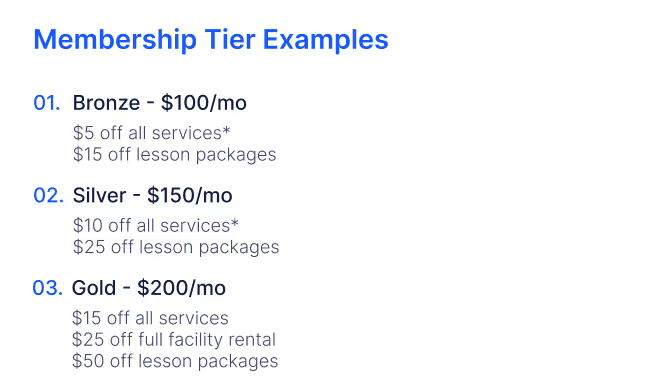
As a recurring fee, memberships offer a steady stream of revenue to your facility. Members typically pay a monthly or annual fee to gain access to exclusive perks. These membership benefits can include perks like access to members-only hours, discounted rates on services, credits, priority booking, and numerous other offers.
Learning from the facilities utilizing Swift, we have learned that tier memberships offer the most flexibility and revenue-generating potential for sports facilities. These tiers are typically constructed into two pricing structures. One relies on membership discounts, while the other leverages credits to offer members cardless online payments.
Here’s a quick look at an example membership tier offering from our Facility Pricing Guide:
3) Lessons, Camps, Clinics and Classes
Graduating from simple space rental, your sports facility can host instructor-led training sessions in a variety of formats. Whether it’s private lessons, holiday camps, or recurring clinics, offering a variety of training options can attract a diverse clientele.
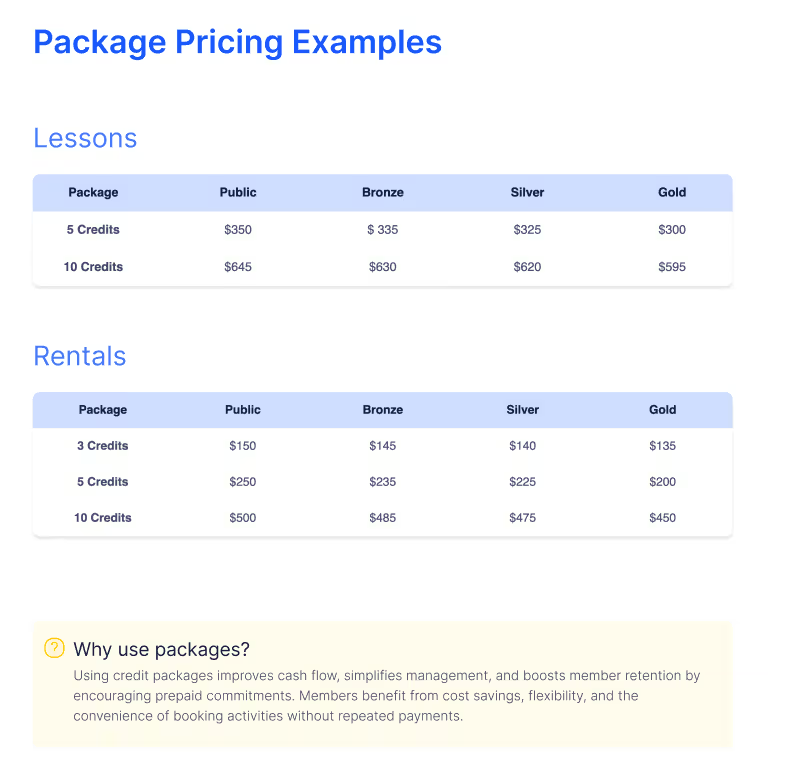
4) Packages & Credits
Building on your service offering, many facilities will offer “packages.” These are bundles of credits towards services purchased upfront, typically at a discounted rate. For example, instructors love offering their regular clients 5, 10, or 15-pack bundles for private lessons. This will encourage customer retention and generate additional bulk spending similar to gift cards.
Below is a typical package offering for a baseball facility.
5) [Bonus] Retail & product sales
While often thought of as a secondary revenue source, high revenue-generating facilities leverage retail & product sales to boost their profits. Many athletes will appreciate being able to grab a quick protein bar or sports drink after their training. While offering custom-designed facility apparel can catch the eye of your members and serve as a secondary marketing tool.
Profitability Factors
The profitability of your indoor sports facility will depend widely on factors such as:
1) Location & Demographics
A facility in a high-demand area with a large population will likely attract more customers and generate higher revenue. Demographics like average household income will also play a large role in determining your profitability.
Scoping the right location is also a balance between scarcity and demand. How many facilities are within a 20-mile radius? How accessible are they by highways? What is the demand for your main sports offering in the area? Furthermore, even if there are rival facilities in the area, if customers are constantly fighting for space, then it still might be a good opportunity for you to open a location nearby.
2) Facility Size
Facilities with larger square footage will have the potential to generate more revenue due to more foot traffic. However, a large square foot will also incur larger costs. A bigger space also means more room for amenities like a dedicated weight room, multi-sport space, parent lounge, etc. For facilities with limited space, it is even more important to tap into revenue streams for off-peak hours.
3) Marketing
Using tactics like flyers and local ads or creating engaging social media content to reach your target audience can significantly impact your sports facility’s success. Offering promotions, creating email marketing campaigns, using paid social ads, sending mobile push notifications, or partnering with local organizations can be a large step forward in attracting and retaining customers.
4) Seasonality
Although your indoor sports facility will be sheltered from the weather, there may still be seasonal trends. For facilities in the Northeast or in Canada, snow days can still impact your business and cause weather-related cancellations (pro tip: create a cancellation policy to negate these last-minute cancellations). Depending on your sport, your revenue will also likely be the highest at certain times of the year when athletes are out of competition. You may notice other trends too like collegiate athletes home for the summer helping give your facility an extra revenue stream.
Average Revenue of an Indoor Sports Facility
So how much can you actually make? The median facility on Swift recorded $72,174 over the last 12 months, the middle half recorded $20,346 to $195,505, and the busiest facilities pass $1M a year.
Profit margins also vary considerably, with many facilities' margins falling between 10% and 20%. Thus, a facility generating $250,000 in revenue might see profits between $25,000 and $50,000.
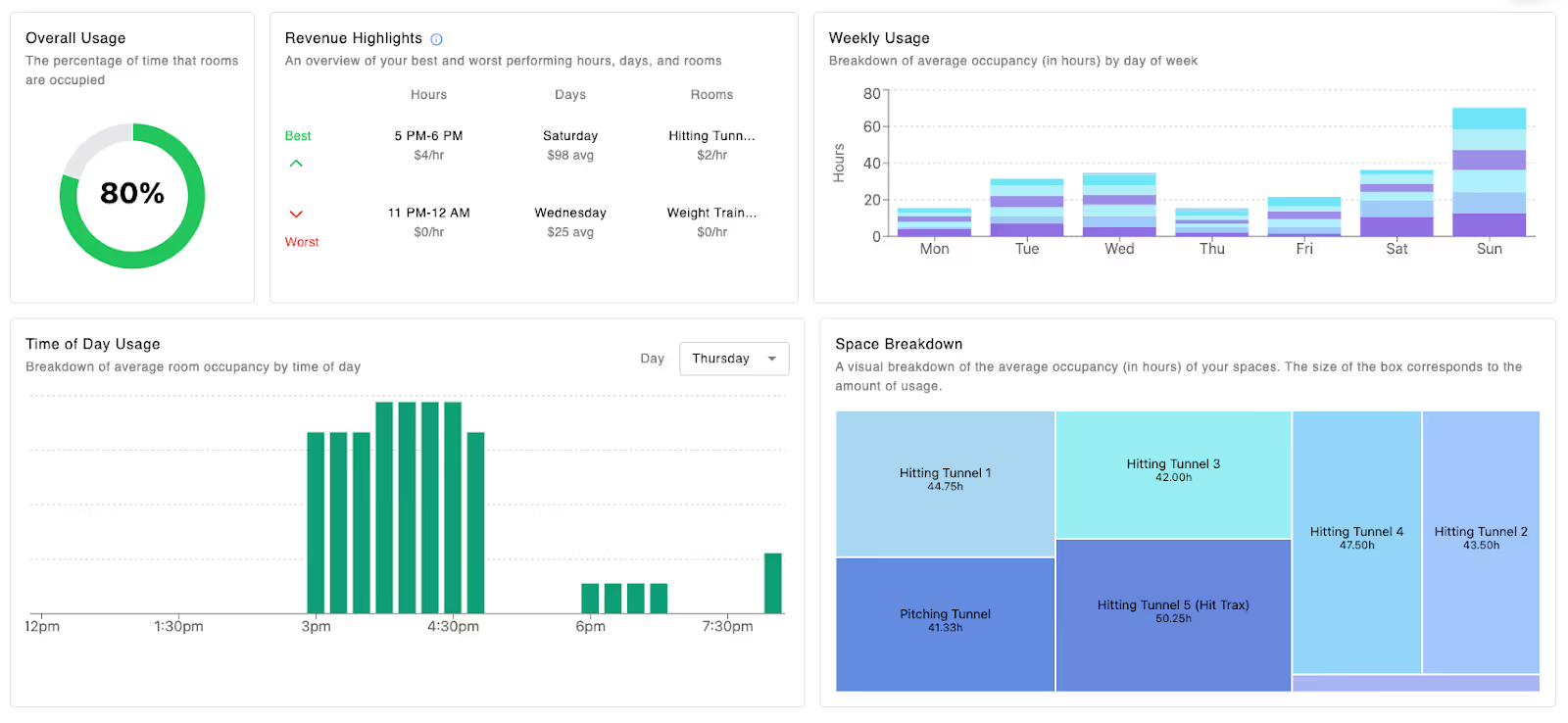
This revenue (and profit) potential depends heavily on utilization. Put simply, the busier your facility is, the more revenue you’ll generate. Most facilities have plenty of room to grow here. Last winter, the median facility on Swift booked each batting cage for about 7 hours a week (342 facilities, Nov 2025 to Feb 2026). At the average facility, 61% of those booked hours started after 3pm on a weekday, against 10% before 3pm. Weekday daytime is the cheapest place to find new revenue, with off-peak pricing, adult sessions or school team rentals. Swift's occupancy report shows how full each space is, hour by hour.
What 10% to 20% margins mean in dollars
| Annual revenue | Profit at 10% | Profit at 20% |
|---|---|---|
| $100,000 | $10,000 | $20,000 |
| $250,000 | $25,000 | $50,000 |
| $500,000 | $50,000 | $100,000 |
| $1,000,000 | $100,000 | $200,000 |
FAQ
How much money does an indoor sports facility make?
The median facility on Swift recorded $72,174 over the last 12 months, and the middle half recorded between $20,346 and $195,505. Our busiest facilities pass $1M a year. With margins of 10% to 20%, a facility doing $250,000 in revenue would keep $25,000 to $50,000 in profit. These numbers only include payments recorded in Swift, so anything a facility doesn't record would add to them.
How do sports facilities generate revenue?
Memberships, rentals and lessons do most of the work. Across 300+ facilities on Swift, the average revenue mix over the last 12 months was 32% memberships, 26% rentals, 16% lessons, 7% camps, 6% packages and 5% classes, with other services making up the rest. Facilities that lean on just one of these tend to feel the slow season the most.
How many members does an indoor sports facility have?
The median facility on Swift had about 36 active members in October 2026, and the middle half had 11 to 84 (442 US facilities). At $91, the median monthly membership price at baseball facilities on Swift, 36 members bring in about $3,300 a month. Memberships are about a third of revenue on average, so most facilities build the rest from lessons, rentals and camps.
Is owning a basketball gym or indoor soccer facility profitable?
It can be. The model is similar to baseball. Team rentals give you a steady base, and training programs and memberships grow the revenue on top. We don't publish basketball or soccer benchmarks yet, so the numbers on this page come mostly from baseball facilities. Either way, the number to watch is how many court or field hours you book each week, especially during weekday daytime.
Which revenue stream earns the most: rentals, lessons, memberships or camps?
On average, memberships. At baseball facilities on Swift, memberships bring in 33% of revenue, compared with 24% for rentals, 17% for lessons and 8% for camps. Members also pay before they book, which helps a lot in the slower months. Team rentals keep the calendar full, and camps and clinics are a great way to fill off-season gaps.
What do the most profitable sports facilities do differently?
They sell more lessons and programs and rely less on rentals. The top-earning quarter of facilities on Swift (median $307,724 a year) gets 23% of revenue from lessons and 14% from rentals. The bottom quarter (median $9,003) gets 8% from lessons and 42% from rentals. Top earners also get meaningful revenue from more streams, three instead of two.
How much does an indoor sports facility make in each region?
It depends on the region, but the ranges overlap a lot. Over the last 12 months, the median US facility on Swift recorded $114,687 in the West, $90,841 in the Northeast, $80,214 in the South and $48,255 in the Midwest. Rent tends to be higher where revenue is higher, so compare both before you pick a location.
What profit margin should a sports facility expect?
Most of the facilities we work with see margins between 10% and 20%. Rent is usually the biggest expense, followed by instructor payroll if you run a lot of lessons. Because those costs stay the same no matter how busy you are, margins go up as you book more hours. Filling off-peak time with programs, team rentals or 24/7 member access is usually the quickest win.
Conclusion
Opening a new indoor sports facility can be a profitable venture if you carefully consider the costs and revenue streams.
Leveraging the reports generated in facility management software like Swift can help you make data-informed choices and plans to increase your profitability. If you found this article helpful and are interested in more tips and tricks on running a successful sports facility, read through our other articles for additional insights.
Ready to run your business on autopilot? Book a free demo to speak to a member of our team.